Mission Statement:
"To advance through research, education and symposia, an increased public awareness of the Cape Fear region's unique history."

"Jonkonnu" or "John Kunering"
or "John Kooner" at Christmas
Cape Fear Historical Instutute Papers
www.cfhi.net
“The John Kuners were a chief attraction of the Christmas
season since colonial times.”
Dr. James Sprunt
An old Christmas tradition of Wilmington called “John Kunering”
is still remembered, with one similar in Edenton referred to as
“John Canoeing.” This was a tradition practiced mainly by black
slaves, a custom that would find noisy and gaily-dressed processions “singing strange tunes accompanied by banjo, accordian, tamborine
and other instruments.” Some of the participants would dress as
women, and they festooned themselves with shreds of cloth sewn
to their daily attire.
In Wilmington, the “John Kuners” would dance throughout the
town to the rhythmic chants of:
“Hah! Low! Here we go!
Hah! Low! Here we go!
Hah! Low! Here we go! Kuners come from Denby!”
“With the rattles of bones, the blowing of cow’s horns, and the tinkling of tambourines, the singing slaves, grotesque in their “Kuner” costumes, would halt whenever an appreciative crowd gathered. Strips of brightly colored cloth sewn to their clothes fluttered gaily as the John Kuners danced merrily.
They were bedecked in horned masks, beards, staring eyes
and enormous noses with grinning mouths.
All were men, but some would dress as women.
After a few songs and dancing, the Kuners would approach the spectators with hat extended to collect a monetary reward for the antics. The Kuners would then depart for another crowd to dance
and sing for and the usual reward”(Johnson).
Slave Harriet Brent Jacobs described the custom (Cashman, p.51):
"Every child rises on Christmas morning to see the John Kannaus.
Without them Christmas would be shorn of its greatest attraction...
a box covered with sheepskin is called the gumbo box. A dozen beat
on this while others strike triangles and jawbones to which a band of dancers keep time. For a month previous they are composing songs."
"John Kunering" was a way in which blacks, free and slave,
would imitate the Christmas traditions in their own manner,
and an opportunity to parade in gaily-dressed musical
groups around the city and request gifts and treats from
white families. Lacking the long Christian traditions
of the annual holiday celebrated by white families, blacks
initiated what may be called a pagan ritual of their own.
The custom fell into disuse in the 1880’s after being tabooed by
black residents, it was seen "as tending to lower them as a race
in the eyes of the public (Moore)."
Though usually viewed as a black custom, historians note that the processions was not limited to blacks, as many white youths would
dress and march as well, joining in the Christmas gaiety.
Slaves Granted Liberty at Holidays:
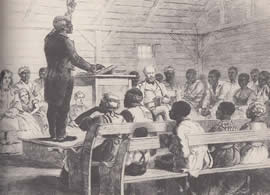
Wilmington historian Louis T. Moore wrote that "At Christmas
seasons especially, a greater degree of real liberty was enjoyed
by the colored people...and they were permitted to band themselves together in groups and from Christmas Eve through the advent of
the New Year, Wilmington verily rang with the chants, songs
and merry-making of the John Kuners. As the groups would stop
in front of the different handsome homes, or pass into the
gardens and spacious yards of the stately houses, they
would always expect some type of Christmas cheer or gift.
Invariably, the Kuners were fed on the substantial viands and
appetizing desserts with which the groaning tables were
filled during the Christmas season.”
There was substantial support for granting slaves the freedom
to enjoy time away from their labor, and antebellum North
Carolina’s Chief Justice Ruffin typified this with his view that:
“It would really be a source of regret, if, contrary to common
custom, it were denied to slaves, in the intervals between
their toils, to indulge in mirthful pastimes…”
Christmas as celebrated by white Wilmingtonians was a quiet and
reflective time with families at home, and author Guion Griffis Johnson
relates in “Antebellum North Carolina” that:
“Christmas in North Carolina was celebrated without official ceremony, and the town authorities ordinarily made no occasion
of the day, “leaving it to quiet church services, visiting parties
and pleasant family reunions.” The Wilmington Daily Journal
wrote on December 23, 1851: “Christmas is coming…and were
it not for the little and big (Negroes) begging for quarters,
and the “noise and confusion” and the “Kooners,” . . .
and the fire-crackers, and all the other unnamed horrors
and abominations, we should be much inclined
to rejoice thereat…”
In 1859 the same Journal wrote that “Christmas is past…
A crowd on foot preceded by an ox team was quite
amusing. John Kuner was feeble. John Barleycorn retained
his usual spirit…our town authorities on Christmas
generally let the boys have their way so far as
mere noise is concerned….much firing of crackers,
rockets, sapients, etc…”
It was customary to give slaves considerable freedom on
Saturday afternoons, Sundays, and on general holidays such
as the 4th of July and Christmas. The old Southern custom
of ladies staying indoors on Saturday afternoons arose from
the great numbers of slaves in town at that time.
Christmas was the time that slaves enjoyed more than others,
and it was a general custom to give the workers a rest from
the field labors for several days at least, and often the
period between Christmas and New Year Day. The masters
were liberal in issuing passes so the slaves could visit relatives
and former masters on neighboring plantations. The slaves
would have more money at this time as masters seldom
forgot to give coins and presents on Christmas morning as
“the slaves gathered about happily shouting
“Chris’mus gif!”
The gifts received were usually gay head-cloths for the
women and “hands of tobacco” for the men, plus
barbequed pork, molasses and weakened liquor. The
Negroes (in Edenton) arose early Christmas morning,
singing their John Canoe songs and shouting “Chris’mus gif”
at their masters’ doors. With liquor on their breaths and
money in their pockets, they spent to day in one long jubilee.”
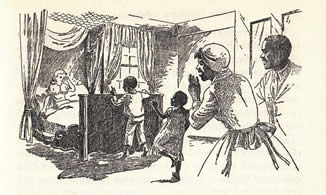
Antebellum slaves in the South were not alone in having annual celebrations. New York slave owners in the late 1700's permitted
their bondsmen several days of recreational release in an event
called "Pinkster," a transformation of the Dutch celebration
of Pentecost. During "Pinkster, the New York slaves
gathered to "make music, dance, and play games."
Another local Wilmington tradition is revealed in
Nicholas Schenck’s diary regarding an antebellum
vacant lot on the north side of Dock Street between
Front and Water Streets, that “was used Christmas holidays
by Negroes to strike at turkeys – suspended on pole –
opposite side of street – paying a small fee – the striker
was blind [folded] – turned around three times [and] given
a street pole – 6 feet long – faced the hanging turkey –
now walk straight ahead – if he killed the turkey or
knock[ed] him down “he won” the turkey.
(UNCW web collections, page 58)
The Origins and “John Canoeing” in Edenton:
The tradition was known by several names and there is no certainty
to the origin of the "John Kuner" custom other that it being possibly
misty African tribal memories and chants mixed with European
traditions, or derived from French, Provencal or Anglo-Norman
minstrels called "Jongleurs," and the name Jonconners," Jonkunnu,” "Jonkonnu," or “Junkanoo” being various corruptions of this.
The term"Jonkonnu" is more a Bahamian term (there called
Junkanoes) and the spelling in Nassau has been "John Canoe"
or John Connu." A more familiar and local identification of the
tradition was "John Kuners" or "Kuners," and it is firmly believed
that the tradition began in Wilmington.
Bahamian historian Gail Saunders writes of the celebration
originating there in the early nineteenth century when slaves took
advantage of the traditional three-day Christmas holdiay observed
by Europeans. Charles Farquharson of Prospect Hill
Plantation on the eastern side of San Salvadore, or Watlings Islands,
recorded in his diary on 26 December 1832 that:
"Some of our people have gone abroad to see some of their friends"
but all of them at home in the evening and have a grand dance,
keeping it up until near daylight." Another white Bahamian observer
noted that he "had never witnessed before a Christmas Day;
the negroes have been beating their tamboines and
dancing the whole day."
It was clear in the Bahamas that "Jonkonnu" was more of a way for
Africans to join in the European Christmas holiday of whites rather than
a tradition brought from West Africa. This may be underscored with
the decline and disappearance of "Jonkonnu" in post-emancipation
years, perhaps the result of the new order of things.
This would occur in the US as well.
In January, 1926 Dougald MacMillan of Chapel Hill, North
Carolina wrote an article in the Journal of American Folklore
entitled "John Kuner" and noted that his research "traced the
custom to only a few other coastal towns of North Carolina,
and to Nassau, where these men were called “John Canoes.”
In Wilmington, the custom apparently died out in the 1880’s."
It is also reported that the "John Kuner" activities of blacks
were in evidence at Somerset Plantation in the Albemarle
region, with some participants dressed bizarrely in rags
and animal skins. They would parade to the master's house
drumming, chanting and dancing for money, food and gifts.
If the tradition is a product of coastal North Carolina, “Kunering”
was most likely derived from black experiences in the New World, absorbing the new culture of the West, and imitating the many
European traditions they found themselves influenced by.
The African influence in “Kunering” cannot be discounted as
nearly-forgotten remembrances of tribal dancing may have
been at work; and slaves recently brought from Africa on
New England slavers certainly would have brought their
memories with them. The high point of the New England
slave trade was about 1750 as it surpassed Liverpool in
prominence as a slave-trading center; and their ships
were still being caught in the 1850’s.
The tradition in nearby Edenton, North Carolina was
explained by Dr. James Norcom in 1824 and he credits
the white community for allowing the custom to flourish:
“During the season of Christmas our slaves…have been in the
habit of enjoying a state of comparative freedom; of having
dances & entertainments among themselves; & of celebrating
the season in a manner peculiar to this part of the world.
These festivities are not only tolerated by the whites, but are
virtually created by them; for without the aid voluntarily
contributed by their masters, the servants would
be destitute of the means of making or enjoying them.
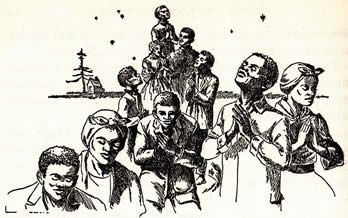
At such a season, instead of driving these wretched creatures,
with cold and unfeeling sensibility from our doors, the heart
of charity dilates towards them, & the angel of humanity
whispers in our ears that they are entitled to a part of the
blessings which their labor has procured us . . . Although
trifling evils sometimes result from these extraordinary
indulgences, they continue to be tolerated and practiced.
It is to be regretted that drunkenness is too common on
these occasions; but this also is habitually overlooked
and never punished, unless it becomes outrageous
or grossly offensive.”
This overview of the traditions of Rodanthe lends some
insights into the origins of the custom, and how Africans
might have adopted their own version of an Old English custom.
Old Buck, John Canoe and the New Year Shooters
“Rodanthe is a little-known village on the Outer
Banks of North Carolina, an island jutting a mile and
a half into the Atlantic. The people of its sandy,
wind-driven shore have always led an isolated life.
But even though the children of Rodanthe – like its
adults – have been cut off from the mainland and
its benefits, they enjoy one advantage over the
youngsters of Raleigh and Charlotte,
Greensboro and Asheville.
In Rodanthe Christmas comes not once but twice
a year. The island observes the Yule holidays in two
sets of spirited ceremonies, one on the “New Christmas”
of December 25, and the other on the “Old Christmas”
of January 5. And the residents of Rodanthe have
something else, a good-natured January 5 mummers’
festival whose star is “Old Buck,” a four-footed
creature who has ridden down a long path out of
ancient English mumming. Old Buck, folklore
authorities say, is a unique survival of a custom
that most modern Anglo-Saxon Americans have
given up or forgotten.
For a long time . . . Christ’s birth was observed
on January 5, but when the British changed their
calendar, most of the colonists followed suit and
accepted December 25 as Christmas Day. Yet here
and there beyond the well-settled areas, in isolated
spots and among people who are perhaps simply
“too independent,” and the January date still
holds sway. Eventually the islanders, at least
to a degree, by observing both the
December and the January date.
Traditionally the [January 5] day began soon after
the dawn with a distant sound of soft music, “real
Christmas music.” A visitor described it as “faint,
eerie,” bordering at first on the supernatural.
“The early morning atmosphere,” he wrote,
“lent a peculiar sweetness.” The music came from
the fife and drums of a band of serenaders, whose
instruments had been passed down from father to son.
The gentle, worshipful procession went from house
to house; on some years, it is said, there were
prayers at each residence. The march continued
for hours, until by dark every home had been
reached. By midday there was an intermission.
The musicians, who had been joined by others
during the course of the morning, arrived at the
spot at which their holiday dinner was to be served.
This was a hearty meal in which roasted oysters, the
succulent specialty of the coast, had a large part.
Then came more visits to homes, and about dusk
Rodanthe’s contribution to the Southern Christmas,
mummers’ night.
On this Old Christmas evening people stepped out
in costume, simple, gay-spirited bandannas, colored
stockings, ancient furs, even more ancient hats.
They made their own masks of cloth or paper with
grotesque noses, long chins and overhanging brows,
or hid their faces inside dark stockings into which
holes had been cut for the mouth and eyes. They
wandered wherever the spirit moved them, hailing
friends, laughing, joking, skylarking.
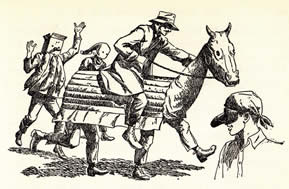
Then the high moment: the arrival of Old Buck,
said the Rodanthians, had once been a monstrous
scourge, the terror of the Hatteras Woods,
who left his retreat only once a year, on January 5,
galloping forth in majesty and also awkwardness.
He consisted of a pole covered with bed quilts
or blankets, and a steer’s head with a fine pair of horns.
At his neck hung a bell.
The two men beneath the quilts cavorted and
danced in a way that made the very young shudder
and their elders giggle. Old Buck’s rider, perched
atop his quilts, directed the monster’s wanderings.
“Caper Buck . . . “ “Straight ahead, now.” Right over
there, fast,” As Buck approached, the crowd swerved,
screamed, and called out encouragement:
“Get ‘em, Buck, get ‘em!” Not until everybody felt tired,
including Old Buck, did the Old Christmas end.
Whether the Rodanthians knew it or not, their custom
went back to earlier English folk ceremonials. From
Cornwall comes a description of “a hobby horse
represented by a man carrying a piece of wood
in the form of a horse’s head and neck, with some
contrivance for opening and shutting the mouth
with a loud snapping noise . . . “ Much earlier,
Staffordshire had a horn dance at Christmas,
with men carrying stag horns on their shoulders.
Clearly Old Buck has English ancestors.
As a large moon rose over an ink-black Atlantic,
the people gathered in their old schoolhouse.
At one end was a stage, at the other benches for
natives and guests. The curtain parted and the
program began. There were singers, dancers,
musicians, and declaimers, most or all in
masquerade and blackface.
Then a pause, and out pounded Old Buck, as fearsome
as ever. On his back rode Santa Claus, impersonated
by a youngster. Here was the new American
Christmas wedded to the old.
For many generations before and after the
Confederate War bizarre celebrations of somewhat
similar origin were held among the Negroes in
other parts of coastal North Carolina. Here was
mumming with an African and West Indian flavor.
Nowhere have I been able to find a parallel to the
“John Canoeing” or “John Kunering” of
several Carolina settlements.
For days before Christmas in such towns as Wilmington,
major port of the area, Negroes whispered their plans
for “John Kuner,” a ceremony whose followers were
supposed to keep their identities well-hidden.
White children, remembering the event from
previous years, talked of it no less.
On Christmas morning there arose a distant sound
of rhythmic chanting, accompanied by instrumental
music. A procession appeared down the street, its members
crying out as they went, and the children of the town
ran to their porches or to the street, to view the line
of blacks with strips of bright-colored cloth attached
to their clothes, or any one of a dozen kinds of
grotesque garb. Each had a “Kuner face,”
a mask with a great nose and beard. Many wore
horns, and all moved in a wild, fantastic style.
Dougald MacMillan, whose description of the
event is most authoritative, explained that even
though the masqueraders were all men, a few wore
women’s clothes, and their high-voiced screeching
added to the merriment. A leader, always an especially
horrendous figure, carried a rawhide whip which he
snapped back and forth, to keep the bolder youths
at a distance. As the procession moved on,
its members sang the traditional chant:
“Hah, lo, here we go!
Hah, lo, here we go!
Hah, lo, here we go!
Kuners come from Denby.”
On and on the singers went, the rhythmic instruments
pounding, the voices rising and falling. Now and
then the songs varied, with a soloist followed by a chorus.
(Soloist): “Young gal go round the corner!
(Chorus): My true love down the lane!
(Soloist): We on the grass where the dew been poured!
(Chorus): Hey, me lady, go down the road . . . “
With their streamers and tatters whirling around them,
the Kuners stopped at the houses of the white people,
or before groups they met on the street, and sang
and danced for them. One of the party held out a hat
to collect money, and then the band strolled on its way.
As [Wilmington historian] Louis T. Moore declared,
“Some of the younger ones were somewhat frightened
at the sight, but it did not take them long to learn
that they had nothing to fear from the Kuners,
and from then on this particular feature of Christmas
was looked forward to with as much eagerness
as was the arrival of Santa Claus himself.”
At one time, the same North Carolinian observed,
there was a single Kuner group in Wilmington,
but it did so well in passing the hat that others
were organized, until there were eight or ten,
each trying to outdo the others, in costume
and music. All of them appeared on Christmas Eve
and throughout the Yule season, the bands
moving nightly up and down the streets.
Nobody could be certain of the custom’s age; some
of the oldest North Carolinians said they had
“always known it.” It thrived in Edenton,
at Hillsboro, near Wilmington, and spread to
a number of places. In 1824 Dr. James Norcom pictured
it at Edenton. There, he said, the slaves were
“in the habit of enjoying a state of comparative
freedom; of having dances and entertainments
among themselves; and of celebrating the season
in a manner most peculiar to this part of the world.”
Had the whites not supported the John Canoeing,
as it was termed at Edenton, it would not have
continued, Dr. Norcom declared. He admitted that
at times drinking was heavy, and “trifling evils”
followed. But, he added, the “angel of humanity”
whispered that the slaves were entitled to “a part
of those blessings which there labors has procured us.”
(Old Buck, John Canoe, and the New Year Shooters,
The Southern Christmas Book, Harnett T. Kane, David McKay Company, Inc., 1958, pp. 89-95)
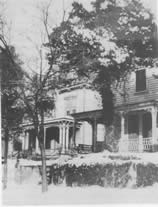
John Kunering in Turn of the Century Wilmington
Emma Woodward MacMillan was born in Wilmington in 1893,
her family home was at 210 North Second Street.
Her published (1961) recollections
(A Goodly Heritage) inform us that:
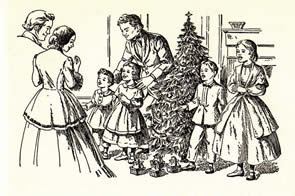
"Under our Christmas tree were always many tarleton bags of
various colors filled with nuts and candies. The hard candies had
come in wooden tubs in our box from Macy's. These bags had
been made by us for the "Kuners" who came in droves to our
house each Christmas day. Most of them were the Negro boys
from the [cotton] Compress, all of them knew Papa and lots of
them knew us. Generally their faces were marked with
the color of the marking ink, a reddish orange, used on the cotton
bales. How exciting it was to have them sit on our geegoggle and
sing their tuneless songs. I confess I was rather afraid of those
grotesque dirty looking figures, but the family took them in as
a matter of course.
Here are two of their songs:
"Ha! low, Here we go, Ha! low, Here we go,
Ha! low, Here we go, Kuners are coming.
Sit still, ladies, and don't take a chill,
While the Captain of the horses ties up big Bill."
There are many more verses I do not recall. Our Aunt Nellie could
keep us amused indefinitely with the ones she knew. They were so
lacking in melody that you could hardly tell one from another.
They were monotonous, more like chants than songs. It was not
until I was at Greensboro at college that I found that the term
"Kuner face," as I used it for the word "mask" had no meaning
that part of North Carolina.
Old John Kuner and his slaves were characters in only three
towns---Wilmington, Hillsboro and Edenton. My older sisters can remember when the Kuners came on horseback. It is of interest
to note three separate ways of spelling the word---
Kooners, Kuners and John Canoes."
John Kooner, “Scotch Hall,” Bertie County, 1849
“The Negroes have a custom here of dressing one of their number
at Christmas in as many rags as he can well carry. He wears a
mask, too, and sometimes a stuffed coon-skin above it, so
arranged as to give him the appearance of being some seven
or eight feet high.
He goes through a variety of pranks, which you will have an
opportunity to see by and by, and he is accompanied by a crowd
of Negroes, who make all the noise and music for
His Worship the John Kooner.
[When morning came] The family were all astir. “Christmas gift!
Christmas gift! Wish you Merry Christmas!” shouted Molly, as
she came to the door. The morning was beautiful. The air was
“frosty, but kindly.” A huge fire was blazing in the parlor, and
an enormous bowl of egg-nogg was already in preparation.
The Negroes were lounging about in holiday attire, awaiting
the customary Christmas dram. This was duly given to them
by Molly, who distributed the whiskey with the air of a queen.
The colonel came into the piazza rubbing his hands, and
caught her in his arms in a genuine doting hug.
Breakfast was announced, and we had barely left the table
when a loud shout beckoned the arrival of the hero of the
Christmas frolic. We hastened to the door. As the Negroes
approached, one of their number was singing a quaint song,
the only words to which that I could distinguish were those
belonging to the chorus: “Blow dat horn, agin!”
On e of them carried a rude deal box, over which a dried
sheepskin had been drawn and nailed, and on this, as if
his salvation depended on it, the man was thumping with
ear-splitting din. Beside him was another, who kept up
a fierce rattle of castanets; another beat a jaw-bone
of some horse departed this life; and still another had a
clevis, which he beat with an iron bolt, thereby making
a very tolerable substitute for a triangle.
The chief mummer, of John Kooner, kept up, in the meantime,
all conceivable distortions of body and limbs, while his followers
pretended to provoke his ire by thrusting sticks between his legs.
One of the party seemed to officiate as bear-leader, to direct
the motions of the unknown chief mummer. They approached
the piazza, knelt on the gorund, and continued to sing, one
of them improvising the words while the rest sang in chorus:
“O! dear maussa! O! dear maussa! Wish ye merry Christmas!
The expected [whiske] dram was given them. A few pieces
of silver were thrown from the piazza, and they left us, singing
a roisterly song, the chorus of which was: “By on de row!
(North Carolina Miscellany, pp. 226-228)
As with many customs and traditions of old, “Kunering” is a thing
of the past in North Carolina, though it is still practiced in Jamaica
and the Bahamas in their own particular style, called by their
name: “John Canoeing.” But even if faintly-recalled African
memories might have somehow influenced the antebellum "Kunering,"
black residents of the 1890's would use the tradition as simply
an occasion to dress grotesquely and parade for gifts and treats
from white families. Perhaps it is better recalled as a
cultural relic of the African slavery a British colonial
system placed in America before the American Revolution,
and time had eventually erased its relevance.
As a postscript it is worth noting that Saunders wrote of the
Bahamian "Jonkonuu" being later revived independent of white
Bahamians but suffering from rival gang fights - then banned after
the Nassau Riot of 1942.
Revived once again in 1967 and claimed to be an "essential expression
of the Bahamian people" it became a Mardi-Gras-like tourist
attraction with participants in brightly colored attire.
Bibliography:
Stories Old and New, Louis T. Moore, Broadfoot Publ’g, 1956/1999
Ante-Bellum North Carolina, Guion Griffis Johnson, UNC Press, 1937
James Sprunt, Chronicles of the Cape Fear, Broadfoot, 1916/1999
Slavery in New York, Ira Berlin & Leslie Harris, NYHS, 2005
A Goodly Heritage, Emma W. MacMillan, WPC, 1961
Historic Bahamas, Gail Saunders, 2010
Cape Fear Adventure, Diane Cashman, Windsor Publications, 1982)
An Independent People, 1770-1820, NC DA&H, 1983
North Carolina Miscellany, Richard Walser, editor, UNC Press, 1962
©2006 Cape Fear Historical Institute