Mission Statement:
"To advance through research, education and symposia, an increased public awareness of the Cape Fear region's unique history."

Benjamin Franklin Grady
Educator, Patriot, Statesman
Cape Fear Historical Institute Papers
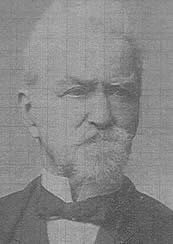
United States Congressman Benjamin Franklin Grady
One of the most distinguished sons of North Carolina
is Benjamin Franklin Grady (pronounced “Graddy”),
an accomplished author and one who served his region
as an educator, Justice of the Peace, Superintendent
of Public Instruction, and United States Congressman
from 1891-1895.
Grady was born on October 10, 1831 near Serecta in the
Albertson Township, the descendant of a great-great-grandfather
who emigrated from Ireland in 1739. He was the oldest son of
Alexander Outlaw and Anne Sloan Grady.
The Grady and O’Grady’s genealogy is traced back to Ireland
in the 4th Century, and in 1365 a John O’Grady is found as
Arch Deacon of Cashell; in 1405 another John O’Grady
was Bishop of Elfin---the cathedral founded by St. Patrick
in the mid-5th Century. A Standish O’Grady was appointed
Attorney General of Ireland in May, 1803 and later served
as a Justice and Chief Baron of the Exchequer.
The first Grady to settle in Duplin County was John, who acquired
fertile land at the fork of the Northeast River and Burncoat Creek
in 1739. He was to marry Mary Whitfield. Two sons of this
union, John and Alexander, were to fight at the Battle of
Moore’s Creek Bridge in 1776; the former losing his life
there and for whom the lone monument memorializes.
After the Revolution, Alexander Outlaw Grady and wife
Nancy Thomas lived on the family farm, and his son Henry,
referred to by the Grady family as “Lord Harry,” married
Elizabeth Outlaw on January 6, 1799. This last marriage
produced Alexander Outlaw Grady on February 17, 1800.
Alexander would marry Anne Sloan, daughter of Gibson and
Rachel (Bryan) Sloan in 1830, and the following year would
witness the birth of Benjamin Franklin Grady.
Grady's Early Years:
Alexander Outlaw Grady was a slaveowner with “twenty-five
or thirty slaves” who were Grady’s playmates and friends
during his childhood, and Grady related that “as I grew up
I hunted and fished with the Negro boys, and worked with
them in the fields and woods except during about three months
each winter when I attended the “old field schools.” He states
that “My boyhood days were spent on the farm, where I
worked with the slaves during nine months of the year…”
As was common in antebellum North Carolina, his father
and neighbors employed a classical scholar to teach their
children ten months in each year from which Grady. benefited,
and in 1851 he was under the instruction of Rev. James M.
Sprunt who taught in the Grove Academy in Kenansville.
Grady entered the University of North Carolina in September
1853 and graduated four years later, returning to Kenansville
to teach two years at the Grove Academy under Dr. Sprunt’s
supervision. He obtained the position of professor of mathematics
and natural sciences at Austin College, located at Huntsville,
Texas, beginning work there in the summer of 1859.
Grady continued in his position until classes were
suspended by impending invasion in 1861, and in his words,
“soon afterwards typhoid fever prostrated me and
unfitted me for military service until May 1862.” Grady
married Olivia Hamilton (a grandniece of Alexander Hamilton)
of Huntsville, Texas and they had one son named Franklin.
Olivia passed away in 1863 whilst Grady was a prisoner of
war, and he later married Mary Charlotte Bizzell of Clinton,
North Carolina in 1870. This marriage produced nine children.
In his own brief biography in 1898, Grady writes of
his father’s prevalent political beliefs:
“By intermarriages his (my great-great-grandfather’s)
blood in my veins was intermingled with that of
the Whitfield’s, Bryans, Outlaws and Sloans. All these
families were Whigs during the Revolutionary War;
and they were advocates of “strong government”
in 1788-1789. Most of them, however, if not at all,
gradually drifted toward Jefferson’s exposition of the
powers of the Federal Government; and my father,
Alexander Outlaw Grady, became a disciple of
John C. Calhoun in 1832-1833, after hearing that
statesman defend his position before the
General Assembly of North Carolina, of which
my father was a member.
In 1860-1861, he was a secessionist.”
Military Service:
Grady enlisted in a local unit which eventually became K
(troop) of the 25th Texas Cavalry Regiment under General
(Thomas C.) Hindman, but was soon dismounted leaving
him to serve as infantry. He served as an Orderly Sergeant
during the war and twice refused the captaincy of a
company in order to carry a rifle, often
detailed as a sharpshooter.
Grady reported of his capture by Northern forces:
“On January 11, 1863 we were captured at Arkansas
Post---about 3000 of us and 45,000 of the enemy
with 13 gunboats--- and carried to Camp Butler
near Springfield, Illinois.”
Grady wrote of the inhuman treatment at the hands
of his Northern captors, writing that Southern prisoners
were shot at by guards for refusing to remove their caps
in the presence of Northern officers, robbed of any
personal effects and exposure to the cold winters with
only a blanket as protection.
In the middle of April 1863 Grady was freed in an
exchange for Northern prisoners held by Southern forces,
and sent to General Braxton Bragg’s command near
Tullahoma, Tennessee. He fought with Bragg’s army
as it moved to North Carolina near the end of the war,
serving in (General Hiram B.) Granbury’s Brigade of
(General Patrick R.) Cleburne’s Division in
(General William) Hardee’s Corps. Grady was lucky
to survive the war in Cleburne’s division as every
officer above lieutenant rank had been killed by the
end of the war, including Cleburne and Granbury.
He participated in all the engagements of his brigade
(excepting Nashville and Bentonville): Chickamauga,
Missionary Ridge, New Hope Church, and Atlanta;
and witnessed the deaths of his commanders Granbury
and Cleburne at the Battle of Franklin
in November of 1864.
Grady writes: “On the 19th of March 1865, while
he cannon were booming at Bentonville, and my
command preparing to leave the railroad for the
scene of action, I was sent by our surgeons to Peace
Institute Hospital in Raleigh where typhoid
fever kept me till May 2.”
Grady lost two brothers in the war, one killed at
Bristoe Station and the other at Snicker’s Gap; his
remaining brother would lose a hand. He was
himself wounded twice, suffering a hand wound
and one to the face that left a deep scar
near the right eye.
Grady describes his view of the South’s war for
independence in the following passage from his
“Case of the South Against the North”:
“I did not agree with my father regarding the
policy of nullification or of secession. While I
subscribed to the doctrine that no State in the
Union had ever relinquished the right to be its
own judge of the mode of measure or redress
whenever its welfare and it peace should be
put in jeopardy by the other States, acting
separately or jointly, I doubted whether the
nullification of a Federal act was consistent
with the obligations imposed by the “firm l
eague of friendship” with the
unoffending States, if any….”
“As to secession, I believed it to be the best
for the Southern States to remain in the Union,
and trust to time and the good sense of the
intelligent people of the Northern States
for justice to themselves and their children.
This hope was strengthened by the
circumstance that the interests of the
expanding West being identical with those
of the South, the time was not far
distant when that section would join the South
in the struggle for riddance of the burdens
imposed by the shipping, fishing, commercial
and manufacturing States of the East.”
Grady concludes by stating:
“this was the stand I took and held until
Mr. Lincoln compelled me to choose whether
I would help him to trample on the
Constitution and crush South Carolina,
or help South Carolina defend the principles
of the Constitution and her own “sovereignty,
freedom and independence.” I went with
South Carolina as my forefathers went with
Massachusetts when “our Royal Sovereign”
threatened to crush her.”
Postwar Life and Teaching:
“without money, without decent clothing, and
suffering from the effects of the fever, I went to
my father’s (home) and obtaining employment in
the neighborhood at my chosen profession,
I waited on him in his last sickness and saw him
die of a broken heart in the year 1867, having
survived the war and lived to see the dark
shadow of “reconstruction” and government
by the ex-slaves hovering over
his beloved Southland.”
Thus Grady returned to his hometown of “Chocolate”
at war’s end. His father dead of a broken heart,
the family servants had scattered,
and the farm was in ruinous condition.
He returned to education and after organizing a school
in Moseley Hall (today LaGrange) and teaching for two
years, he established the Clinton Male Academy with
fellow teacher Murdock McLeod at nearby Clinton
(Sampson County). There Grady taught until failing
health in 1878 forced him to return to his Duplin
County family homestead to farm where he, his
father, grandfather, and great-grandfather were born.
Grady continued to teach at his home, and provided
instruction for young men unable to attend the university;
and additionally conducting Sunday school at Sutton’s
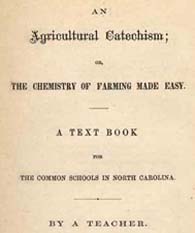
Branch School House. In 1867 he published a school
textbook entitled “An Agricultural Catechism,”
and would go on to write two more books at the
end of the century.
Public Service:
The mid-1870’s would see Grady begin a long career
of public-service beginning with Justice of the Peace
(1878-1889); appointed a Trustee of the re-established
University of North Carolina in 1874 (serving until
1891 when congressional duties limited his time);
and elected Superintendent of Public Instruction for
Duplin County in 1881, serving in that capacity for eight
years. While serving as Superintendent, brother Stephen
Miller Grady held the post of Chairman of the
Board of Education as both advanced the cause
of education in Duplin County.
Grady was elected twice as a United States Representative
to Congress from the Third District (Democrat), serving in
Washington City from March 1891 to March 1895 in the
52nd and 53rd Congresses. He was known by his
congressional colleagues as “the encyclopedia as
his mind remembered everything. He campaigned for
repeal of the Sherman Act of 1890, writing the
New York Times on June 11, 1893 from
Wallace, North Carolina:
“I prefer a cheap money of our own. I will vote to
repeal the Sherman law with a free coinage
substitute and a tax on State banks. Let the
people rather than the Government
control money volume.”
Benjamin Franklin Grady held political views consistent
with his North Carolina roots, especially regarding the
War Between the States. In May 1894 while serving
as a US Representative he penned a response to a
Pennsylvanian in which he reflected upon the dismal
outcome of that war. He condemned the
“cranks, fanatics and unscrupulous tyrants” who
were in national political power and regarded
his own State of North Carolina as a conquered
province of the victorious North. He saw the
unbridled military power of the Washington
government unleashed during the War as dangerous;
and verbally attacked the “advocates of imperialism”
who viewed the globe as their own.
His viewpoint on the War Between the States as this:
“the cause of the South was the cause of Constitutional
government, the cause of government regulated by law,
and the cause of honesty and fidelity in public servants.
No nobler cause did ever man fight for!”
Grady was wary of politicians and government,
and saw that “Extravagance is almost unavoidable when
the method of taxation enables the Legislature to lay
unperceived burdens on the shoulders of the taxpayers.”
He saw too the dangers of unrestrained democracy
and demogogues as:
“written constitutions present no effective barrier to
the avarice of classes, the ambition of individuals,
the schemes of party, or the machination of fanatics;
and so long as the mass of the people are unable
to understand the structure and administration of
their Government, they will continue to be dupes of
callow statesmen and professional office-seekers,
and victims of misgovernment."
He looked to future generations of Americans to recognize
misgovernment and to strive for the vision of the Founders
by stating:
“We cannot retrace our steps or right the wrongs
of the past; but it is not too much to hope that a
more enlightened generation now entering
upon the duties of guarding themselves and
their posterity from recurrences of the mistakes
of the past, may strive to restore and vivify the
principles on which alone any just government
can be founded, and by reestablishing the system
of governments in and between these States
which our fathers hoped would be “indestructible,
“insure domestic tranquility” and “secure the
blessings of liberty” to themselves and their posterity.”
Return to Teaching:
In 1899 Grady established the Turkey Academy
(in Turkey, NC) with son Henry Alexander who had
studied law at the University of North Carolina. Since
1896 Henry had been working as a law clerk with his
half-brother Franklin, an attorney in New York City,
who had earned a law degree at Georgetown University.
In 1900, Henry would leave the Academy in the summer
of 1900 to pursue a short law course at the University of
North Carolina, and being licensed to practice by the
Supreme Court in September 1900. For three years he
was a member of the firm Faison & Grady of Clinton,
his partner being the well-known Henry Faison.
He afterward became a partner of Archie McLean Graham,
a connection that was maintained for twenty years. In 1922
he was elected to the bench of the County Court in Sampson
County and continued to serve in that capacity until
January 1, 1939, when he retired and under law became
emergency judge of the Superior Court for life.
After Henry Alexander’s departure, Grady would spend
his last years “teaching and pursuing literary work.” His literary
retirement gave him time to write two exceptional books, the
first published in 1899 entitled “The Case of the South
Against the North; and the second published in 1906,
“The South’s Burden.” Both are articulate and well-reasoned
Constitutional arguments regarding the Southern States
struggle for independence from 1861-1865. They are
currently reprinted and available
through www.confederatereprint.com.
Benjamin Franklin Grady died on the 6th of March, 1914
and is buried in the Clinton Cemetery.
Grady’s son Henry Alexander went on to legal success
as mentioned above, and the other siblings were Cleburne;
James B.; Stephen S.; Benjamin; Louis D.; Lessie R.;
Mary Eva; and Anna B. Grady.
It is said that Benjamin Franklin Grady was a
lover of literature and:
“as scholarly a man as ever lived (and a) first class
man in Greek, Latin, French, and mathematics at
the university, a born teacher, (and) conveyed
to his son(s) his knowledge in such a way the son’s
education is equal to that of any college graduate.”
After his death, the Sillers Chapter of the United Daughters
of the Confederacy in Clinton wrote the following about
Grady in their periodical, the Southern Cross:
“Franklin, as he was called by the family, attended the
old field schools and was prepared for College by the
Rev. James Sprunt. Among his classmates were
Colonel Thomas S. Kenan, Judge A.C. Avery,
Major Robert Bingham, Dr. D. McL. Graham,
Captain John Dugger, Honorable John Graham,
and many others of like kind, who have helped to
make history honorable in North Carolina.
Two of his brothers had been killed in the war, one
at Bristoe Station and one at Snicker’s Gap; while
the remaining brother had lost the use of a hand.
He saw that it was necessary to build up a New South
upon the ruins of the past.
Teaching was his chosen profession and he believed
that in the education of the people lay the
salvation of the country.”
Sources:
Dictionary of North Carolina Biography, William S. Powell, 1986
Henry Alexander Grady, Biographies of Leading Men, L. Wilson, 1916
Case of the South Against the North, B.F. Grady, 1899
The South’s Burden, The Curse of Sectionalism, B.F. Grady, 1906
North Carolina: Old North State and the New, A. Henderson, 1941
©2006 Cape Fear Historical Institute