
Mission Statement:
"To advance through research, education and symposia, an increased public awareness of the Cape Fear region's unique history."

Alfred Moore Waddell, Enlightened Wilmingtonian
Cape Fear Historical Institute Papers
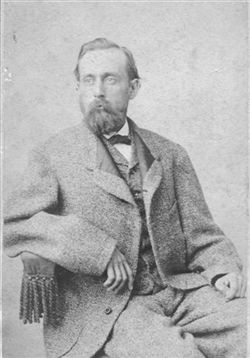 |
Colonel Alfred Moore Waddell |
Early life at “Moorefields.”
“My earliest recollections are of an old plantation in
“the back country,” as the region of middle North Carolina
was called by the people of the sea coast. It had been the
summer residence of my ancestor, Alfred Moore, a Justice of
the Supreme Court of the United States, and the old mulberry
tree under which tradition said he used to read law after his
admission to the bar, was still standing in my youth.
At the time of which I write it (Moorefields) was the summer
residence of his son, of the same name, my grandfather, who was
a rice planter on the lower Cape Fear, and a man of extraordinary gifts as a conversationalist, an orator and bell-lettres scholar,
who was for many years a member and speaker of the House
of Commons of the State.
On this plantation Thomas Hart Benton, Senator from Missouri,
was born and passed his early years, his grandfather, Thomas Hart, Sheriff of the county, having owned part of it in the Colonial period, and it was the scene of several incidents during the Revolution,
among which may be mentioned the hurried trip of Colonel
David Fanning, the Tory leader, when, on a raid he captured Governor Burke and his suite at Hillsborough in September, 1781
and took them through the plantation on his way to Deep River
and thence to Fayetteville and Wilmington….”
"As I look back and recall the happy days spent on that old place
they seem to be seperated from me by a hundred years and are wrapped in a tender mist of indescribable memories."
Alfred Moore Waddell, 1908
Statesman, Jurist and Scholar of the Cape Fear
Early Life, Marriage and Career:
Colonel Waddell was born in Hillsborough, North Carolina on 16 September 1834, the son of Hugh and Susan Moore Waddell,
“both of distinguished Lower Cape Fear lineage.” Waddell was the
great-grandson of three of North Carolina’s greatest Revolutionary
leaders, General Hugh Waddell, Justice of the US Supreme
Court Alfred Moore, Colonel J.P. Williams, and General Francis Nash. The latter was killed at Germantown, Pennsylvania on October 4, 1777 and the city of Nashville, Tennessee is named for him. Waddell’s
father’s mother was the only child of General Nash.
Waddell was educated as a young man at Bingham’s School and the Caldwell Institute in Hillsborough, and graduated from the University of North Carolina in 1853. He then studied law “with such distinguished
jurists as John L. Bailey, William H. Battle, Frederick Nash and Samuel
H. Phillips,” and was admitted to the North Carolina bar in 1855. He
then moved to Wilmington which was the home of his forebears and
began his practice of law. He married Elizabeth Savage in1857, who
gave birth to Elizabeth Savage Waddell and Alfred M., Jr. After the
death of his wife, Waddell married her sister Ellen Savage in 1878.
He married a third time in 1896 to Gabrielle de Rossett.
The newly-opened Thalian Hall at Third and Princess Streets held its grand opening on "Friday, December 3rd, 1857 presenting "The Invisible Prince or The Island of Tranquil Delights, described as a "musical fairy extravaganza in four acts," (and the) leading role of Don Leander was played by Alfred Moore Waddell."
Waddell first entered public office in 1858 as Clerk of the Court of
Equity in New Hanover County, a position he held until 1861. A
devoted Conservative and Unionist in political philosophy, be
supported the American Party ticket in 1856 and the Constitutional
Union Party in 1860. He served as a North Carolina alternative delegate
to the Constitutional Union Party convention in 1860.
North Carolina Unionist:
As he strongly opposed the growing secessionist movement in the South, he purchased the Wilmington Herald as a platform for his views, editing this unionist newspaper from 1860 to 1861. He viewed the citizens action to seize Forts Caswell and Johnston near the mouth of the Cape Fear in early Jauary as precipitous, and editorialized on 11 January 1861:
"As a public journalist, who is supposed to reflect in some degree
the sentiments of this community, we protest agaisnt the illegal
and unjustifiable conduct of those citizens who have gone to the aid
of men who possess the Forts at the mouth of our river. The people
of Wilmington do not justify, or countenance such proceedings.
Nine-tenths of the community are opposed to it. They feel that it
is depriving the State of North Carolina of her character for integrity, and is weakening the moral force of whatever action she may see
fit hereafter to take. As a matter of justice to the people of Wilmington, we desire to make it known that the conduct of
these gentlemen finds little sympathy, and does not meet the
approval of a large majority of our citizens."
As secessionist sentiment in Wilmington grew after South Carolina's departure from the federal Union, it was furthered by the "Star of the West" expedition sent to resupply Fort Sumter---which had caused the seizures
of the forts noted above. By the end of January a meeting was held, the object of which "was to establish unity of feeling in the community."
At this January 29th meeting, Waddell spoke and declared "that the time
he had never hoped to see, had arrived, and that in his opinion there was no longer any hope for the Union, and if North Carolina was true to
herself, and her history, she would take her stand with those with whom
her desitiny lay, and at once sever the ties which bind her to the Northern States." He then "pledged himself to use all his efforts to effect harmony and unanimity of sentiment in the community."
North Carolina unionists like Waddell had earlier hoped for solutions to the secession crisis within the Union, the same Union fought for by their patriot fathers and grandfathers. With President James Buchanan's "Star of the West" expedition that not only illustrated disdain for South Carolina's regained sovereignty, but also an aggressive policy of the federal government to coerce a State, those like Waddell were convinced that there would be no hope of compromise in a sectional Lincoln
administration dominated by Northern industrial and abolitionist interests.
He witnessed the bombardment of Fort Sumter after rushing to the city of Charleston by train:
"On the evening of April 10, 1861, the telegraph operator at the Wilmington office confidentially communicated to me at the (Wilmington Daily) Herald office a telegram that had just passed through from General Beauregard to Jefferson Davis at Richmond, saying that he would open fire on Fort Sumter at 4 a.m., if Major Anderson refused to surrender. Thereupon I hurried to the old "Manchester Depot" opposite to the Market Street dock on the
other side of the (Cape Fear) river, and caught the train for Charleston as it was passing out. I described the trip to a New York audience in 1878 in the following brief sentences:
"I shall never forget that, after a night of great anxiety, and when about twenty miles from the city, just as the first grey streaks began
to lighten the eastern sky, and when the silent swamps were wakened only by the rumble of the train, there was distinctly heard a single
dull, heavy report like a clap of distant thunder, and immediately following it at intervals of a minute or two, that peculiar measured throb of artillery which was then so new, but afterwards became so familiar to our ears.
The excitement on the train at once became intense, and the engineer, sympathizing with it, opened his valves, and giving free rein to the iron horse, rushed us with tremendous speed into the historic city. Springing from the train and dashing through the silent streets we entered our hotel, ascended to the roof, and here I experienced sensations which never before or since have been mine.
As I stepped into the cupola and looked out upon that splendid
harbor, there in the center of its gateway to the sea, half wrapped in the morning mist, lay Sumter, and high above its parapets, fluttering in the morning breeze floated proudly and defiantly the
stars and stripes. In a moment afterwards just above it there was
a sudden red flash, and a column of smoke, followed by an explosion, and opposite on James Island, a corresponding puff floated away on the breeze, and I realized with emotion indescribable that I was looking upon a civil war among my countrymen."
After Lincoln called for 75,000 troops from the State's to invade
South Carolina, Waddell and other Unionists knew their earlier decision
to support and pursue self-detemination for North Carolina was a proper one. He offered his services in defense of North Carolina first as an Adjutant, and later as Lt. Colonel of the North Carolina Third Cavalry in 1863 and 1864. This unit was later designated the Forty-First North Carolina Regiment, from which he resigned in 1864 due to poor health.
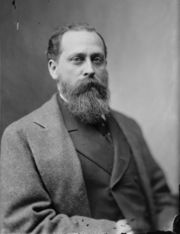
After the War Between the States:
When the war ended, he advocated peaceful readjustment with the
North as well as Conservative political initiatives for the South as
homes and industry were rebuilt.
On July 26th, 1865, he was asked by leading black citizens to address
“the colored people…at the Wilmington Theatre (Thalian Hall). There
he “denounced taxation without representation and advocated the future extension of the suffrage to those of the Negroes that were qualified for
the privilege” (Wilmington Sentinel, August 8, 1865).
Waddell encouraged voting rights for black citizens who like their white counterparts, met intelligence and property requirements. At the same
time, Wilmington had a garrison of black occupation troops which
brought great unrest to the black population. Hel wrote to
Reconstruction Governor Holden that “outrages by the [Negro]
troops were of daily occurrence and that the effect of the colored
troops on the Negro population was very dangerous.”
As great latitude was given to the occupation troops and their hostile behavior toward white citizens, and there was little redress of citizen complaints. A black riot was feared after a demand was made
“that they should have some city offices and made threats when they
were refused.” Waddell’s concern caused the Governor to promise
swift punishment of rioters, and he began mustering out black troops
in September 1865.
With the restoration of home rule in 1870, he was elected to the
Forty-Second Congress for four terms as a Conservative-Democrat.
While serving in Congress, Waddell appointed Wilmingtonian
Edwin A. Anderson to the United States Naval Academy in 1878,
from where he graduated in 1882. Anderson went on to win the
Congressional Medal of Honor twice for extraordinary heroism
during the Spanish War, and at Veracruz in 1915.
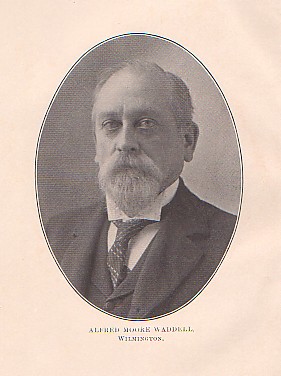
While in Congress and Chairman of the Committee on Post Offices
and Post Roads, sponsored a bill to encourage steamship
communucation and establish lines between New York and Rio de
Janeiro, and another at New Orleans. Waddell saw this as a way to achieve increased trade between the two countries.
Waddell Quells Race Riot:
Waddell was called upon again to restrain racial hostility in the early 1870’s, when according to the memoirs of Wilmingtonian and US Congressman John D. Bellamy,
“Wilmington and New Hanover County were absolutely under
the control of a large Negro population, which had drifted there
from South Carolina and other parts of the country, attracted by
the Freedmen's Bureau, a national institution that gave rations
and clothing to the newly emancipated slaves; a howling mob
of Negroes, being led by a notorious white man by the name of
James Heaton, seized and took possession of the town; several thousands of the mob smashing windows, ruining property, and
were about to set fire to the town.
“The weak and puny carpetbagger government, which even the Negroes did not respect, could not quell the riot. Alfred Moore Waddell, calling together a handful---hardly more than one
hundred---of brave and fearless men, with a gun in his hand, led
a charge on the large mob of Negroes, put it to flight, and in less
than an hour drove the rioters to their homes and restored order.
The weak and pusillanimous government continued to function
once more in peace.
Colonel Waddell, at the time, was a writer, who dropped his
books and responded to the appeal to have order restored.”
Bellamy wrote of Waddell’s high character and described him as
“a member of Congress (who) made a national reputation as an orator and campaigner…a man of courage, and in trying
times was a leader.”
An Acclaimed Orator in Demand:
On June 15, 1875, the cornerstone of the Temple Israel was laid with impressive ceremonies. Colonel A.M. Waddell an address and the
Masons laid the stone. The Temple would later by led by Rabbi Samuel Mendelsohn, who began services in February 1876.
His retirement from political office allowed him an opportunity to write
and speak, and his oratorical abilities were widely respected. With
the latter, “His polished eloquence and commanding stage presence brought to him a continuous flood of requests throughout the State
and elsewhere to deliver addresses of all kinds---commencement,
patriotic and historical.” Waddell delivered political campaign speeches
as far away as Maine and New York in 1880 in behalf of the
Democratic ticket.
A highly respected and accomplished Wilmingtonian, it is not uncommon to hear him described thusly: “Colonel Waddell’s
superior talents, remarkable power of speech, pleasing personality and his courteous address were known to all men.”
Scholar and Author in Retirement:
Waddell’s literary accomplishments of considerable merit are found in the publication of three books, A Colonial Officer and His Times, 1754-1773, General Hugh Waddell (1890); Some Memories of My Life (1908); and
A History of New Hanover County and the Lower Cape Fear Region, 1723-1800 (1909). Waddell’s abilities as an author are underscored
by noted Cape Fear historian James Sprunt who comments “that
he had not read a sea-tale “comparable to Colonel Waddell’s thrilling
story “Pilots in a Storm.” Its descriptive, dramatic strength reminds one
of Victor Hugo’s weird “Story of a Gun’; but Colonel Waddell’s story
is true in all its details, as it tells of a tragedy in which five devoted
Cape Fear pilots went down to death.”
Return to the Political Arena:
The political upheavals of the 1890’s and ascent of opportunist
Daniel Russell to the governor’s office in 1896 brought Waddell out
of retirement in support of the Democratic ticket. Though referred to as
the “white supremacy” campaign of 1898, it was a predictable
reaction to the fusion of black Republican voters with disenchanted
white Populists led by Governor Russell, an opportunist and outcast
of the Republican party itself. The Democrats and most white
citizens of the State feared a return to the corrupt and financially
devastating rule of Republicans experienced during Reconstruction.
Waddell wrote in 1908: "Long continued evils borne by the
community with a patience that seems incredible . . . culminated on
the 10th day of November [1898] in a radical revolution
accompanied by bloodshed and a thorough reorganization of
social and political conditions. It is commonly referred to as
the Wilmington riot, and legally and technically it may be properly
so termed, but not in the usual sense of disorderly mob violence,
for, as was said by an army officer who was present and witnessed
it, it was the qu.ietest and most orderly riot he had ever seen or
heard of."
He adds: "A Negro printing office was destroyed by a procession of perfectly sober men, but no person was injured until a Negro
deliberately and without provocation shot a white man, while others,
armed and defiant, occupied the streets, and the result was that
about twenty of them were killed and the rest of them were
scattered."
(Some Memories of My Life, 1908, pg. 242-243)
Waddell was elected mayor of Wilmington after the unpopular
Republican aldermen, half of whom were appointed by Russell,
had resigned in accordance with the City Charter.
As mayor, “Waddell quickly restored sobriety and peace,
demonstrating his capacity to act with courage in critical times.”
Knowing that many black residents had fled to the woods to escape
the violence, he sent "search parties of kindly disposed white men
into the woods to bring them back to safety and comfort."
(Hayden, pg. 22)
Waddell continued in this office until 1905, leading a responsible and
honest government unaffected by the racial turbulence of 1898.
In May, 1900, Waddell was a guest speaker at the "Southern
Society for the Promotion of the Study of Race Conditions and
Problems in the South, held in Montgomery, Alabama.
Welcomes UDC Convention to Wilmington:
In November 1901 the annual convention of the United Daughters of
the Confederacy was held in Wilmington and as mayor, welcomed them
to this historic city. In his address, he said “As one who bore a humble
part in the service of the Confederacy I reverently salute you the wives, sisters, and daughters of my comrades, the noblest army of heroines
and patriots that ever trod the earth.” He went on to say that:
“Your organization is unique in human annals, as was the
struggle whose memories you seek to preserve. The dreamer and sentimentalist may fold his hands, and with a sigh exclaim that
history will do justice between the parties to that struggle; but experience has shown that history, like Providence, helps those
only who help themselves, and will honor only those who help
her to record the truth. You will readily admit that if the Southern people had remained silent, and had used no printer’s ink after
the war, they would have been pilloried in history as Rebels
and traitors who had, causelessly and without a shadow of
excuse, drenched the land with the blood of unoffending patriots.
But the Southern people did not remain silent; they published in
a thousand forms the truth, both as to the causes which impelled
them to assert their rights and as to the battles in which they maintained them, and have thus made a partial, unjust and one-sided history impossible. In this work the Memorial Association first,
and after them the United Daughters of the Confederacy, have
been the most heroic and devoted, and they may justly claim a
large share of the credit for successfully vindicating before the
world the causes which their Southern countrymen engaged, and
in which thousands of them sacrificed their lives.”
Colonel Waddell was ever mindful of the sacrifices made by
North Carolinians in defense of their State, and the oration above
displayed his expertise in verse, and sentimentality for those patriots
who fell. In a later oration delivered to the Alumni Association of the University of North Carolina on May 31, 1892, Waddell related an
experience on the sands of Fort Fisher at the mouth of the Cape Fear
River below Wilmington, as he remembered the Old North State
patriots who fought and perished there in defense of their families,
homes, State and fortunes:
“Recently I stood at night, on the narrow peninsula where
twenty-seven years ago fleet and fort proclaimed in thunder the
fame of Fort Fisher. To the eastward heaved the sea, on whose
rolling billows the rising moon poured a flood of silvery light,
while opposite, and hanging low above the shining river in
limitless depths of the western heavens, glowed the serene orb
of the evening planet, whose glories heightened as it
neared the horizon.
Between lay the long line of ragged mounds over which the tide of battle ebbed and flowed when the expiring hopes of a brave people were forever extinguished. Beneath wave and mound alike patriot bones were bleaching, mute witnesses of the horrors of civil strife
and of the emptiness of human ambition. Higher rose the goddess
of the night. Wider grew the sheen upon the waters, lower and
more luminous sank the star.
A solemn stillness, unbroken save by the voices of the night wind
and the sea, reigned supreme….As I watched that evening planet sinking to its rest a voice within me whispered,:
"So, too, to the patriot’s eye there is no vision more grateful
than the career of him who, forgetful of self, and mindful
only of the rights and liberties of his fellow men, gives his
life to their service, and with the luster of his virtues ever
brightening to the end, passes from their view.”
Alfred Moore Waddell died on March 17th, 1912 in Wilmington at
the age of 77. He is buried in Oakdale Cemetery.
Bibliography:
Chronicles of the Cape Fear, James Sprunt, Broadfoot Publ'g, 1916/1992 North Carolina, A. Henderson, Lewis Publishing, 1941, page 656
Dictionary of North Carolina Biography, W. Powell, UNC Press, 1986
Memoirs of an Octogenarian, John D. Bellamy, Observer Printing, 1941
Confederate Veteran Magazine, November, 1901, page 485-486
Some Memories of My Life, A.M. Waddell, 1908 The Wilmington Rebellion, Harry Hayden, 1936 Wilmington During the Civil War, Thesis, H.J. Beeker, 1941 Politics in Wilmington/New Hanover, Jerome McDuffie, 1979 Editor in Politics, Josephus Daniels, UNC Press, 1941
John Roach: Maritime Entrepreneur, Swann, US Naval Institute, 1965
©2006 Cape Fear Historical Institute